Training and Utilizing Directional Drilling
Directional drilling is the practice of controlling the direction and deviation of a wellbore to a predetermined underground target or location. This article describes why directional drilling is required, the sort of well paths that are used and the tools and methods employed to drill those wells.
As a technique, directional drilling allows oil and gas well operators to approach a potentially productive area without the need for a well to be drilled directly above that area. A central site can service multiple well bores that reach multiple locations at non-vertical angles. This reduces the number of well facilities that must be built and maintained. Not needing to build new wells may also lead to the exploration of smaller reservoirs that would otherwise be uneconomical. Directional drilling is also used in the development of mines in order to reduce the risk of potentially dangerous gas ruptures. In-mine drilling techniques allow companies to create bore holes far in advance of the mine face.
Although the fundamental concepts of directional drilling date back to the 19th century, it has become a more popular technique as computer-aided technology has become more common. Early directional drilling involved pointing the drill bit at an angle other than vertical, resulting in a straight line away from the well. Modern drilling techniques allow the use of the drill bits that can bend, allowing engineers to adjust the direction the well is drill in to a certain degree. This can be accomplished through the use of hydraulic jets. Moreover, the angle of the drill bit being used to bore the well can be adjusted by a computer using GPS signals to pinpoint the location of an oil and gas field. Engineers create 3-D models of the field to determine the best location for the well, and the best approach for the bore to follow.
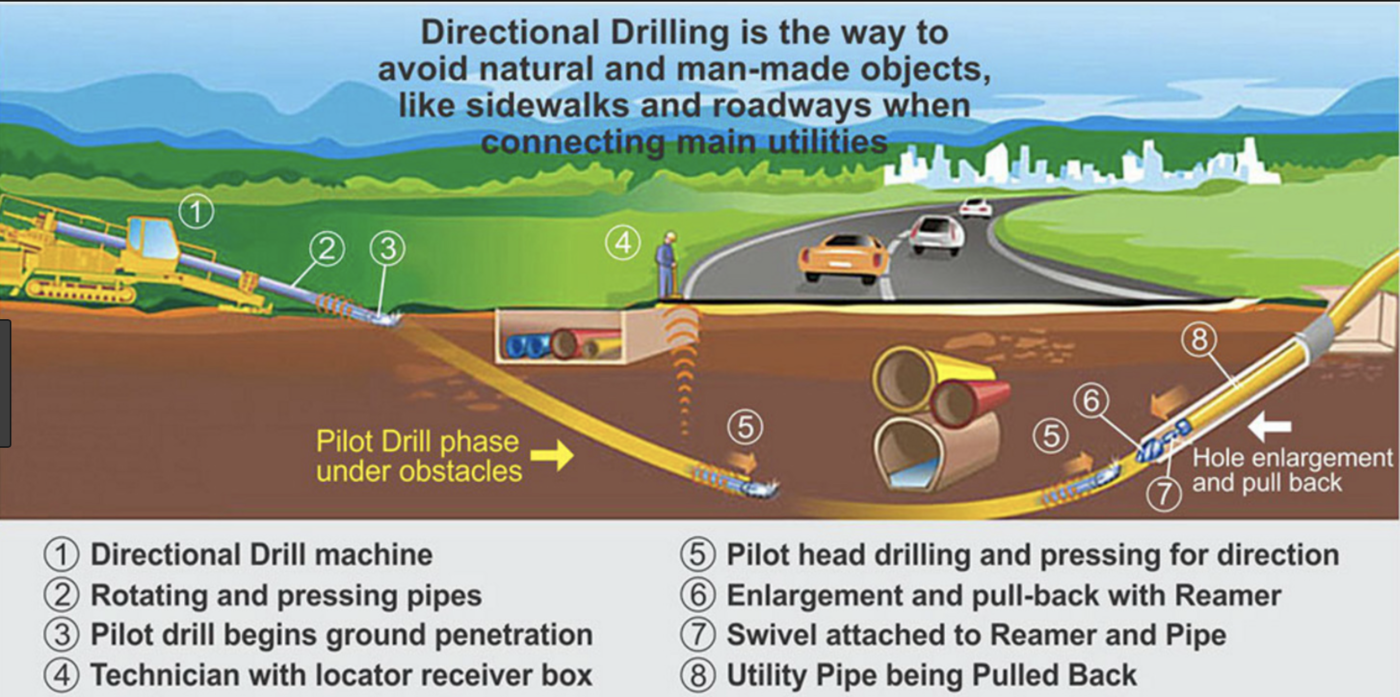
While the ability to install underground pipework without digging large channels saves money and time, and directional drilling is rightly praised for that, it is that ability to install piping and other underground equipment without disturbing the surrounding environment that is perhaps the most important aspect. In notable projects, such as the rollout of new fiber broadband equipment by both Comcast and Google, the ability to install conduit without any disruption to pavement, roads, businesses, homes, etc. not only makes directional drilling valuable, but also enables projects to be carried out when previously you would see public opposition due to the levels of disruption these projects posed.
Directional drilling is not just cost efficient and time saving, but it also enables projects that might otherwise be impractical or be delayed for years due to legal challenges to move forward. This perk of directional drilling has made it increasingly popular, and as more projects adopt drilling to avoid extensive excavation, the need for skilled directional drilling machine operators grows with it. In fact, this has become one of the most in-demand skillsets in construction today.
